So let’s talk about how to change the world.
In US schools they teach you about how a bill becomes a law. This is one way of changing the world - previously a rule or activity did or did not exist, and now the opposite. The curriculum goes into a lot of detail about who proposes and who votes and who vetoes, but the important thing is that it’s not you or me, but an elected official. The US school system tells us the way that you and I have an input on changing the world is that we choose our elected officials, and they change the world for us.
In this scenario, these elected officials are what I’ll call ‘decision makers.’ Once they’re elected, unfortunately they don’t have very much accountability until the next election cycle, but you can still let them know what changes you want them to make, which might look something like this:
![Four node diagram: (Make a petition) into (Get signatures) into [Decision Makers] downward into ((Desired Change))](organizing_with_bayes/img_1.png)
Using a petition, you can show your decision maker that the change you desire is supported by many of the people they make decisions for. Ideally, this would then get them to take the desired action. But both in and out of the political-legal sphere, sometimes decision makers don’t care about how widely or deeply felt a particular desire for change is. In which case, the diagram starts to look like this:
![Four node diagram as above, but with the arrow from (Get signatures) into [Decision Makers] removed.](organizing_with_bayes/img_2.png)
So now that I’ve eased you into it, let’s talk about the math we’ve secretly been doing behind the scenes.
So those diagrams above are called Bayesian networks - so called because they use Bayes’ theorem, which gives us the definition of a conditional probabilityP(A|B), aka the probability of event A occurring given that B also occurred. Each circle oval in the diagram is an event, and an arrow drawn between them represents a probability. For example, if you make a petition about an issue people really care about, P(Get signatures | Make a petition) is higher than if you made the petition were about something niche. Similarly, if you get a lot of signatures, it’s more likely to influence decision makers’ to implement the desired change. So each of these arrows are also associated with values which represent the strength of the causal correlation, aka the success of the endeavor.
So what did it represent when we deleted the arrow between Get signatures and Decision Makers? I’m getting a little sloppy with the notation, but it means that the causal link between those two nodes was removed - it doesn’t matter how many signatures you get, the probability of decision makers swaying their behavior in any way is uncorrelated. If a decision maker doesn't care about representing the desires of the signers, it doesn’t matter if you have 100 signers or 1 million signers - you could exhaust yourself getting all the signers in the world, and still not see the change you need. This diagram applies pretty well to most other ways to make your voices heard, such as protesting. Multiple millions of attendees convening to make a single statement is a powerful message, but if the decision makers don’t feel a need to listen, then that message won’t matter.
But that isn’t to say petitions and protests aren’t effective, even if decision makers don’t care. They’re just not working in the more direct way we expect them to. To show how they work, we’ll need to do a little working backwards.
All decision makers care about something. Under capitalism, usually it’s money. For example, the reason we don’t have a carbon tax is because it would be ‘disruptive to the economy’. Sometimes it’s social pressure: Teachers’ strikes make school administrations answer to their parents about why they cannot educate or care for their kids. For a specific decision maker, the things they care about can be numerous and varied, and sometimes unexpected. But generally speaking, we’ll refer to this category as ‘disruption to business as usual.’
![Three node diagram: (Disruption to business as usual) into [Decision Makers] downward into ((Desired change))](organizing_with_bayes/img_3.png)
The problem with disrupting business as usual, or generally doing things against the wishes of decision makers, is that decision makers usually have a lot of power, and can and will use that power to minimize disruption. So if you, by yourself, refuse to work, or pop tires til you get a carbon tax, you’re most likely to be fired and/or arrested, and decision makers will move on, knowing that the disruption has been handled. So it turns out the diagram looks a little more like this:
![Four node diagram, the same diagram as above, but the arrow from [Decision Makers] downward into ((Desired change)) branches off to (Retaliation)](organizing_with_bayes/img_4.png)
At any given point, decision makers have the choice to either retaliate or make the desired change. The only option is to make it such the retaliation itself would be just disruptive. And in order to do that, there’s really only one way available to people like us, which is to get a lot of us, working together. What we need is a collective capability and willingness to cause disruption.
![Five node diagram, the same as above, but now there is an arrow from [[Collective Capability to Disrupt]] into (Disruption to business as usual). Also the following nodes now move downwards instead of the the right. This is for convenience.](organizing_with_bayes/img_5.png)
So, now we’re finally back to why petitions and protests still matter. Under this formulation, they serve two purposes. First is to bring people into this collective capability to disrupt. The target audience is not just decision makers, but everyday people like you and me. With petitions, you get a list of names and contact info to bring them into our collective capability. Similarly, at protests, you find people who are willing to get out there on the streets and get organized.
![Three node diagram: (make a petition) and (hold a protest) both into [[Collective Capability to Disrupt]]](organizing_with_bayes/img_6.png)
The second purpose - well, unfortunately we have to talk about math again. So each of these arrows represents a conditional probability, eg p(Petition Signatures | Collective Capability to Disrupt). Thing is, our collective disruption capability isn’t directly quantifiable - you can’t point to it and say “it’s precisely this big”, unlike, say, the number of signatures on a petition. Per Bayes rule, though, you can estimate the “flip” of P(A|B), or in our case, P(Collective Capability to Disrupt | Petition Signatures). Protest attendance works the same way: if your numbers continue to grow, that’s a sure sign your Collective Capability to Disrupt is growing as well.
![Seven node diagram, same as the preceding five node diagram, where we added [[Collective Capability to Disrupt]]. This diagram adds two nodes after [[Collective Capability to Disrupt]], (# of petition signatures) and (protest attendance)](organizing_with_bayes/img_7.png)
Since this collective strength is what protects us from retaliation, being able to estimate this is very important - we don’t want to move towards risky actions if the decision makers are more likely to retaliate than capitulate. It’s also important because neither party, decision makers nor the people, really want to disrupt things. Boycotts and strikes and other types of disruption aren’t pleasant for anybody involved. Signaling a strong capability for disruption allows decision makers to estimate that collective power and can persuade them to make the desired change without having to actually cause disruption.
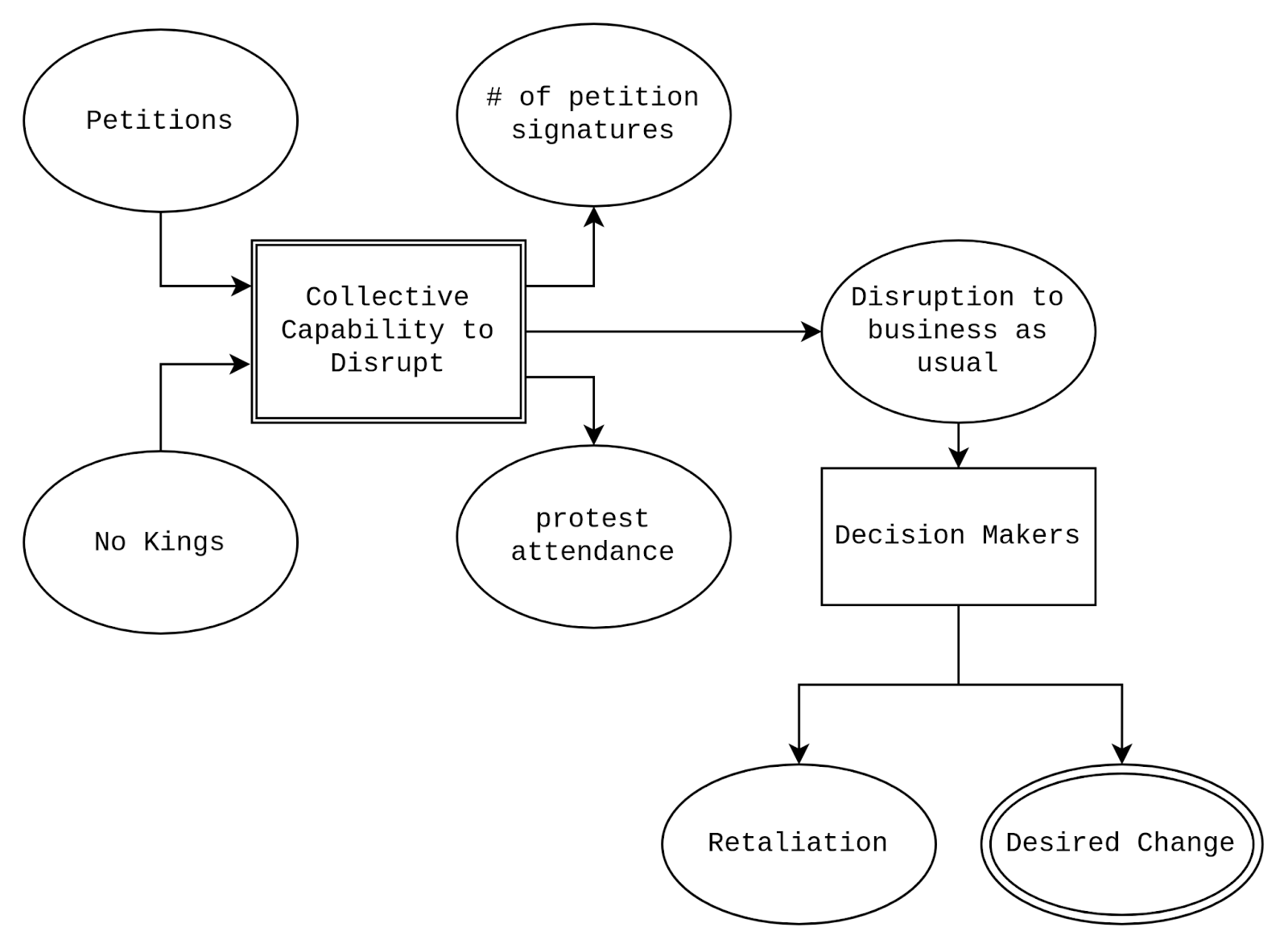
Putting it all together, this is what we’ve got:
![Nine node diagram: (make a petition) and (hold a protest) point into [[Collective Capability to Disrupt]] into (# of petition signatures) and (protest attendance) as well as (Disruption to business as usual). (Disruption to business as usual) points into [Decision Makers] which points into (Retaliation) and ((Desired change))](organizing_with_bayes/img_8.png)
So, in summary: even if your decision makers have uncorrelated their decision making from the direct input of the people, petitions, protests, and other mass-mobilizing tools do still work. The causal chain is just a little longer and more complicated, and requires an understanding of the underlying collective power.
So what now? We’ve got this mathematical model of organizing, but a model’s no good unless you can use it to explain or predict things. So let’s use it to discuss some tactics and applications you find in organizing.
Petition Fatigue
In many ways, this is what inspired this increasingly long scrawl. As our governments increasingly do stuff we don't want, petitions abound to try to get it to do something different. But we see very little change coming about because of them. This might be for one of two reasons:
The first is that they may be ineffective. As a reminder, all the arrows are associated with probabilities, some of which are higher than others. So if you send up a petition and then never reach out to any of the signers ever again, it's very unlikely that those signers will actually join or participate in this collective disruptive capability. A petition that you follow up with and help people get educated, trained, and plugged into the organizing movement has a much higher probability of contributing to the collective capability. This leads to another pitfall where people who sign one petition are likely to sign other ones, and therefore already be plugged into collective power - so organically circulating petitions may not reach the most important audience: people who are not yet involved in organizing. In our diagram, this “probability of plugging in” is represented by this arrow:
![Two, two node diagrams. Both have a node from (make a petition) into [[Collective Capability to Disrupt]]. On the left, the arrow is labeled "Petition with no followup" and has a dashed line. On the right, the line is labeled "Petition with followup", and has a thicker arrow](organizing_with_bayes/img_9.png)
The second reason may be that they're doing all of the above: finding new individuals, following up with them, getting them plugged in and trained up - but all of this is highly invisible from the outside, so it's easy to forget that they are having the intended “change", but not the kind that’s easy to see.
This misunderstanding of how and why petitions work also leads to an overindexing on the exact verbiage of the petition. When decision-makers are paying attention to the petition, specific verbiage has a strong influence on what change we’ll see in reality. But when decision makers aren’t paying attention, the primary audience changes from the decision makers to potential members of the collective capability - and since building this collective capacity is a long-term endeavor, the specifics of the desired change can and should be refined as it progresses.
No Kings
No Kings is unique in that it’s one of the only anti-fascist events that mainstream media is willing to broadcast. But after three events, it’s clear that its massive turnout is not enough to reverse the course of fascism in the United States. Even escalating amounts of participation - which is a great sign - may not be enough to pressure decision makers, because while this collective is growing, decision makers remain unconvinced that will result in a high probability of disruption: the events are unequivocally non-violent, and their economic disruption is limited to one Saturday every few months, which is an “acceptable” level of disruption for the powers that be. For decision makers, No Kings is seeing the big arrow pointing towards attendance, but deciding that the arrow that corresponds to meaningful disruption doesn’t correspond to a probability that’s high enough to worry about:
![Three node diagram, [[No Kings]] in the place of "Collective Capability to Disrupt" into (protest attendance) which as a thick line and into (Disurption to business as usual) with a thinner, dotted line](organizing_with_bayes/img_10.png)
But, just like petitions, that doesn’t mean it’s not useful. Again, No Kings helps bring together individuals and other organizing movements to build that collective capacity for disruption. But, that does mean that it’s not enough just to attend No Kings protests and then go home. You have to talk to the people who are there, find ways to get plugged in, and together tackle the systemic and cultural barriers to the sustained disruption that has been proven to be successful.